
Introduction
Natural disasters can affect every family, but for children with autism, a sudden disaster can create additional challenges.
A major mountain-related disaster can happen very quickly. Floodwater, landslides, debris, damaged roads, power outages, evacuation, unfamiliar shelters, loud sounds, and separation from familiar surroundings can completely change a child's daily environment.
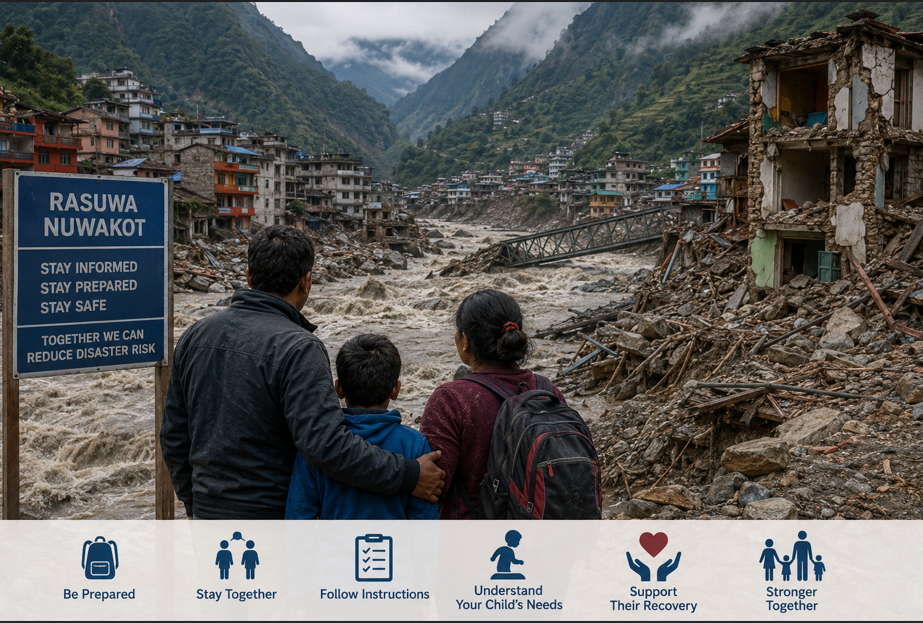
The catastrophic event in Rasuwa on 26 August 2026, followed by impacts along the Bhote Koshi and Trishuli river corridors including Nuwakot, has demonstrated how rapidly a mountain-origin disaster can affect communities far downstream. The Government of Nepal and WHO reported extensive impacts on communities, infrastructure, health services, transportation, and emergency response. The precise sequence that triggered the Rasuwa flooding continues to be investigated.
This situation is particularly important for families raising autistic children.
An autistic child may have difficulty communicating during an emergency, coping with sudden changes, tolerating unfamiliar sensory experiences, or understanding why normal routines have suddenly disappeared.
This article is therefore not only about the disaster itself.
Its main purpose is to help parents understand:
What risks can autistic children face during and after a disaster, and what can parents do to protect and support them?
Understanding Mountain-Related Disasters in Nepal
Nepal's geography creates several types of natural hazards.
The country contains high Himalayan mountains, glaciers, steep slopes, narrow valleys, major rivers, and settlements located along river corridors and mountain roads.
Because of this geography, communities can be exposed to hazards such as:
- Flash floods
- Glacial Lake Outburst Floods (GLOFs)
- Landslides
- Debris flows
- Rockfalls
- Avalanches
- Earthquakes
- River flooding
Some of these events can occur with very little warning.
What Is a Glacial Lake Outburst Flood?
A Glacial Lake Outburst Flood (GLOF) occurs when water stored in or around a glacial lake is suddenly released, producing a powerful downstream flood.
Nepal has a significant history of GLOF events and continues to have areas that require monitoring.
ICIMOD's inventory of glacial lakes in the Koshi, Gandaki, and Karnali basins identified 21 potentially dangerous glacial lakes in Nepal as part of a wider regional assessment. These lakes can pose risks to downstream communities and infrastructure if they breach.
GLOFs are only one example.
Mountain communities can also experience sudden flooding caused by combinations of landslides, avalanches, ice or rock movement, temporary river blockages, and the rapid release of water.
The Rasuwa Disaster: Why It Matters for Families
On 26 August 2026, severe flooding affected parts of central Nepal.
According to WHO Nepal, communities along the Bhote Koshi and Trishuli river corridors were affected, including Rasuwa, Nuwakot, Dhading and Chitwan, with other districts also affected. The initial flooding in Rasuwa followed a sudden surge of water into the Bhote Koshi River, possibly associated with an upstream ice avalanche and temporary damming of the Lhende River; investigations are ongoing.
The Government of Nepal reported severe loss of life and property and initiated search, rescue, relief, and rehabilitation efforts.
The event demonstrates an important point for families:
A mountain disaster does not necessarily affect only the location where it begins.
Water and debris can travel downstream through connected river systems, affecting communities far from the original mountain source.
For parents of autistic children, this means disaster preparedness should not depend only on whether a family lives directly beside a glacier or at the disaster's point of origin.
Families living along vulnerable river corridors and in other hazard-prone areas should understand their local risks and know where to seek safety.
Why Autistic Children May Face Additional Risks
Autism does not automatically make a child physically more vulnerable to a flood, landslide, or earthquake.
However, certain characteristics associated with autism can create additional challenges during emergencies.
These may include:
1. Communication Difficulties
Some autistic children may have limited spoken language or may be non-verbal.
During an emergency, they may have difficulty telling others:
- “I am hurt.”
- “I am scared.”
- “I am hungry.”
- “I am thirsty.”
- “I need the toilet.”
- “I want my parent.”
- “Something hurts.”
This can make emergency assessment more difficult.
2. Difficulty Understanding Sudden Danger
A child may not understand why everyone suddenly needs to leave the house.
They may not understand:
“The water is dangerous.”
“We have to evacuate.”
“This building is not safe.”
Simple, repeated explanations may therefore be necessary.
3. Sensory Overload
Disasters can create an unusually intense sensory environment.
A child may experience:
- Sirens
- Helicopters
- Loudspeakers
- Crowds
- Generators
- Flashing lights
- Mud
- Rain
- Strong smells
- Unfamiliar clothing
- Physical contact from unfamiliar people
A child who is already sensitive to sound, touch, light, or certain textures may become extremely distressed.
4. Loss of Routine
Many autistic children find predictable routines helpful.
A disaster can suddenly change:
- Wake-up time
- Meals
- School
- Therapy
- Sleeping location
- Bathing
- Toileting
- Transportation
- Family routines
This sudden loss of predictability can increase anxiety and behavioral distress.
5. Unfamiliar Environment
An emergency shelter, relative's house, school building, or temporary camp may contain unfamiliar:
- People
- Sounds
- Smells
- Beds
- Food
- Toilets
- Lighting
- Rules
For some children, this can be overwhelming.
6. Risk of Wandering or Becoming Separated
Some autistic children may wander or move away from caregivers, particularly when frightened or overwhelmed.
During an evacuation or crowded emergency situation, parents should therefore pay particular attention to supervision and identification.
Children who are attracted to water may also require additional precautions around flooded areas and rivers. Autism-focused disaster preparedness guidance specifically recommends considering wandering and water-safety risks during emergencies.
The Risks Do Not End When the Water Goes Down
One of the most important messages for parents is:
After the immediate danger has passed, children may still experience difficulties.
The family may face:
- Displacement
- Loss of home
- Interrupted schooling
- Interrupted therapy
- Loss of familiar belongings
- Medication shortages
- Poor sleep
- Changes in eating
- Fear
- Anxiety
- Communication difficulties
- Behavioral changes
- Separation from family members
- Uncertainty about the future
For an autistic child, these changes can continue to affect daily functioning long after the physical disaster has ended.
BEFORE A DISASTER: Parent Preparation Guide
Preparedness is one of the most useful things a family can do.
Parents do not need an expensive or complicated plan.
A simple child-specific emergency plan can make a significant difference.
1. Prepare an Autism Emergency Bag
Keep a small emergency bag that can be taken quickly.
Consider including:
Communication
- Communication cards
- Picture cards
- Notebook and pen
- Communication device if used
- Phone
- Charger
- Power bank
Comfort
- Favorite toy
- Familiar blanket
- Comfort object
- Headphones or ear protection
- Sensory items used by the child
Food and Water
- Safe drinking water
- Familiar snacks
- Foods the child is comfortable eating
Health
- Regular medication
- Medication list
- Prescription information
- Important medical information
- Healthcare contact numbers
Identification
Include:
- Child's name
- Parent's name
- Emergency contact
- Address
- Communication method
- Important medical information
Disaster preparedness guidance for autistic families also emphasizes having emergency supplies, critical information, communication plans, and information about the child's individual needs ready before an emergency.
2. Create a One-Page Child Information Card
This can be extremely useful during an emergency.
Parents can prepare a card containing:
Child's Name: ___________________________
Parent/Caregiver: ___________________________
Emergency Contact: ___________________________
Communication: ___________________________
Medical Information: ___________________________
Medication: ___________________________
What May Cause Distress: ___________________________
What Helps the Child Calm: ___________________________
Important Safety Information: ___________________________
This card can be shown to healthcare workers, rescue personnel, teachers, volunteers, and other caregivers.
3. Prepare a Communication Plan
Parents should decide:
- Who will stay with the child?
- Where will the family meet if separated?
- Who should be contacted?
- How will the child communicate?
- What information should emergency workers know?
If mobile networks are unavailable, keep important phone numbers written on paper.
4. Plan the Evacuation Route
Families living in potentially vulnerable areas should identify:
- Safe higher ground where appropriate
- Official evacuation locations
- Alternative routes
- Family meeting points
- Places to stay temporarily
Do not wait until floodwater or a landslide is approaching to decide where to go.
Always follow official evacuation instructions.
5. Practice Before an Emergency
Children can benefit from simple practice.
Parents can practice:
“When we hear this warning, we leave.”
“Take the bag.”
“Hold my hand.”
“We are going to a safe place.”
Practice should be calm and age-appropriate.
The goal is familiarity, not fear.
DURING A DISASTER: What Parents Should Do
1. Physical Safety Comes First
Move away from danger according to official instructions.
Do not return to unsafe buildings, bridges, riverbanks, or roads simply to collect belongings.
After flooding, hazards may remain even when water levels fall.
2. Keep the Child Close
During evacuation:
- Stay physically close.
- Hold hands where appropriate.
- Use identification information.
- Keep the child's emergency bag nearby.
- Avoid leaving the child with unfamiliar people unless necessary and safe.
3. Use Short Instructions
Avoid long explanations during an emergency.
Use simple statements:
“Come with me.”
“We are leaving.”
“Stay here.”
“This place is safe.”
“Hold my hand.”
One instruction at a time may be easier to understand.
4. Reduce Sensory Overload
If possible:
- Move away from loud noise.
- Use headphones or ear protection.
- Reduce unnecessary physical contact.
- Keep a familiar comfort item nearby.
- Find a quieter area.
- Maintain a calm voice.
Do not punish a child for becoming distressed.
The behavior may be a response to fear or sensory overload.
5. Do Not Force Communication
A frightened child may communicate less than usual.
Do not repeatedly demand: “Tell me what happened.”
Instead, offer alternatives:
- Pointing
- Pictures
- Gestures
- Writing
- Communication devices
- Simple yes/no questions
Observe behavior carefully.
6. Inform Emergency Workers
Tell responders clearly:
“My child has autism.”
Then explain the child's most important needs. For example:
“My child may not speak.”
“Please speak slowly.”
“Loud sounds may cause distress.”
“My child uses pictures to communicate.”
“Please allow me to stay with my child.”
Clear communication between families and responders is an important part of disaster risk reduction. UNDRR emphasizes that effective risk communication helps people understand risk and take appropriate action.
POST-DISASTER: THE PARENTAL GUIDE
The First Priority: Rebuild Safety
After reaching a safe location, parents should focus on:
Safety → Food and water → Health → Medication → Communication → Sleep → Routine → Recovery
Parents do not need to immediately restore everything exactly as it was before.
Start with the basics.
1. Re-establish a Simple Routine
Even if the family is living temporarily somewhere else, create a basic schedule.
For example:
Wake up ↓ Breakfast ↓ Wash ↓ Quiet activity ↓ Meal ↓ Rest ↓ Play ↓ Dinner ↓ Sleep
A temporary routine can give the child some predictability when everything else has changed.
2. Watch for Behavioral Changes
After a disaster, parents may notice:
- More crying
- Increased irritability
- Withdrawal
- Increased repetitive behaviors
- Difficulty sleeping
- Changes in appetite
- Increased attachment to parents
- Fear of certain sounds
- Difficulty separating from caregivers
- More frequent meltdowns
- Temporary changes in communication
These changes can occur as a response to stress and disruption.
They should not automatically be interpreted as a permanent change in the child's autism or development.
3. Pay Attention to Non-Verbal Signs
A child who cannot easily explain how they feel may communicate through behavior.
For example:
- Refusing food
- Becoming unusually quiet
- Crying
- Holding a particular body part
- Changes in movement
- Changes in sleep
- Increased aggression
- Avoiding activities
Parents should consider whether the child may be experiencing:
- Pain
- Fear
- Hunger
- Thirst
- Exhaustion
- Sensory overload
- Anxiety
4. Protect Sleep
Sleep can be disrupted after disasters.
Try to recreate familiar sleep conditions where possible.
Use:
- Familiar blankets
- Familiar clothing
- A familiar bedtime routine
- Reduced noise
- Lower lighting
- Familiar bedtime activities
Even when the surroundings are temporary, maintaining a predictable bedtime sequence may help.
5. Maintain Medication
If the child takes prescribed medication, parents should try to maintain access and follow the prescribing professional's instructions.
Keep medication information together with the emergency documents.
If medication has been lost or supplies are running low, contact an appropriate healthcare provider.
Do not change or stop prescribed medication without professional medical advice.
6. Food and Sensory Needs Matter
Emergency food distributions may not always contain foods that an autistic child is comfortable eating.
If the child has strong food preferences or sensory-related feeding difficulties, parents should explain this to relief workers when possible.
A child who refuses unfamiliar food may not simply be “being difficult.”
Texture, smell, appearance, temperature, or unfamiliarity may affect acceptance.
Safe familiar foods can therefore be useful in an emergency kit.
7. Therapy May Be Interrupted
A disaster can temporarily interrupt:
- Speech therapy
- Occupational therapy
- Physiotherapy
- Behavioral intervention
- Developmental services
- School
Parents should not feel guilty if therapy cannot continue during the immediate emergency.
Safety comes first.
When services become available again, professionals can help the child return gradually to appropriate routines and developmental goals.
8. Returning to School
Returning to school can help restore normality, but it should happen when the environment is safe.
Teachers and parents should communicate about:
- Changes in the child's behavior
- Sleep problems
- Communication difficulties
- New fears
- Sensory difficulties
- Changes in routine
- Academic difficulties
A child may need additional time and support to adjust.
9. Talk About the Disaster Simply
Children may not understand what happened.
Use simple explanations. For example:
“There was a very big flood.”
“Our home was not safe, so we came here.”
“You are safe now.”
“People are helping us.”
Avoid repeatedly exposing the child to frightening videos or graphic disaster images.
Give truthful information without unnecessary frightening details.
10. Allow Time for Recovery
Every child responds differently.
Some children may return to normal quickly.
Others may remain distressed for longer.
Parents should focus on:
- Safety
- Predictability
- Familiarity
- Connection
- Communication
- Rest
- Gradual return to everyday activities
Recovery does not need to happen all at once.
WHEN SHOULD PARENTS SEEK PROFESSIONAL HELP?
Parents should consider professional assessment if significant changes continue or interfere with the child's daily life.
Seek appropriate healthcare or developmental support if a child:
- Remains extremely distressed
- Has persistent sleep problems
- Stops eating or drinking adequately
- Shows a significant change in communication
- Loses previously acquired skills
- Becomes unusually withdrawn
- Shows persistent severe anxiety
- Has ongoing unexplained physical symptoms
- Experiences repeated severe behavioral episodes
- Cannot return to basic daily activities
If the child has an immediate medical emergency, serious injury, severe dehydration, breathing difficulty, or another urgent health problem, seek emergency medical care immediately.
SPECIAL CONSIDERATIONS FOR NON-VERBAL OR MINIMALLY VERBAL CHILDREN
Children who use little or no spoken language may require additional planning.
Parents should prepare:
A communication card
Show how the child communicates.
A needs card
Explain:
- How the child expresses pain
- How the child expresses hunger
- How the child expresses fear
- How the child asks for the toilet
- What the child finds distressing
A calming plan
List:
- Favorite objects
- Sensory supports
- Preferred activities
- Calming strategies
This information can help unfamiliar people understand the child more quickly.
A SIMPLE “AUTISM DISASTER PLAN”
Parents can remember five key areas:
1. IDENTIFY
Make sure the child can be identified.
2. COMMUNICATE
Prepare information about how the child communicates.
3. PROTECT
Keep the child away from water, unstable buildings, roads, debris, and other hazards.
4. COMFORT
Carry familiar sensory and comfort items.
5. RESTORE
After the emergency, rebuild routine and stability gradually.
PARENT EMERGENCY CHECKLIST
Before the Disaster
- Emergency contacts written down
- Child identification prepared
- Communication card prepared
- Medication packed
- Medical information available
- Familiar food packed
- Safe drinking water available
- Comfort item packed
- Sensory supports packed
- Phone and charger available
- Power bank available
- Evacuation route identified
- Family meeting point identified
During the Disaster
- Follow official instructions
- Move to a safe location
- Keep child close
- Use short instructions
- Use visual communication if needed
- Reduce sensory overload
- Keep medication accessible
- Inform responders about the child's needs
- Avoid unsafe rivers, bridges, buildings, and debris
After the Disaster
- Check for injuries
- Check food and water intake
- Continue essential medication
- Re-establish a simple routine
- Support sleep
- Monitor behavior
- Monitor communication
- Reconnect with healthcare services
- Reconnect with therapy services when available
- Communicate with school
- Seek professional help if significant problems persist
What Parents Should Avoid
During and after a disaster, parents should try to avoid:
Forcing the child to speak
Communication may temporarily decrease under stress.
Punishing distress behaviors
A meltdown may reflect fear, sensory overload, or confusion.
Suddenly changing medication
Medication changes should be discussed with an appropriate healthcare professional.
Forcing unfamiliar food
Where possible, provide safe and familiar alternatives.
Returning to unsafe locations
Do not risk the child's safety to recover belongings.
Overloading the child with information
Keep explanations short and understandable.
Assuming every behavioral change is “just autism”
New behavior after a disaster may indicate stress, pain, illness, or another unmet need.
Why Nepal Needs Autism-Specific Disaster Preparedness
Disaster preparedness is often discussed at the level of households and communities.
However, children do not all experience emergencies in the same way.
Families of autistic children may require additional planning for:
- Communication
- Sensory needs
- Medication
- Food
- Identification
- Supervision
- Routine
- School continuity
- Therapy continuity
- Emotional recovery
Nepal's mountain geography makes disaster preparedness particularly important. Research by ICIMOD has documented significant exposure to glacial-lake and related mountain hazards, while recent events demonstrate how rapidly a mountain-origin disaster can affect downstream communities.
This does not mean that every mountain community will experience a major disaster.
It means that preparedness should be part of responsible family planning in areas where hazards are possible.
A Message for Parents
A disaster can make a child feel that the whole world has suddenly changed.
For an autistic child, that change may be even harder to understand.
The home may disappear.
The school may close.
Therapy may stop.
Favorite belongings may be lost.
Normal meals may change.
The child may suddenly be surrounded by unfamiliar people and sounds.
Parents cannot control every part of a disaster. But they can prepare for some of the challenges.
- A communication card can help.
- A familiar toy can help.
- A medication supply can help.
- A simple routine can help.
- A calm parent can help.
- Clear information can help.
Most importantly, understanding the child's individual needs can help others provide safer and more compassionate support.
Key Takeaways
However, communication, sensory, behavioral, and routine-related differences can create additional challenges during emergencies.
A small emergency bag and child-specific emergency plan can be extremely useful.
Parents should prepare simple ways for the child to communicate and explain the child's needs to emergency workers.
During an active disaster, follow official instructions and move away from danger.
Behavioral and emotional changes can continue after the immediate danger has passed.
Even a temporary routine can help an autistic child understand what comes next.
Parents should prepare information about how the child communicates pain, fear, hunger, thirst, and other needs.
Persistent or severe changes should be discussed with appropriate healthcare, developmental, or mental-health professionals.
Conclusion
Nepal's unique geography means that mountain-related hazards such as flash floods, GLOFs, landslides, debris flows, and other cascading events can pose serious challenges to communities.
The 2026 Rasuwa disaster is a powerful reminder that mountain-origin hazards can affect communities far beyond their point of origin.
For families raising autistic children, disaster preparedness should include more than food, water, and shelter.
It should also include:
communication, sensory needs, identification, medication, supervision, familiar routines, and post-disaster emotional and developmental support.
The goal is not to frighten parents.
The goal is to help them feel prepared.
A simple plan made before an emergency can reduce confusion when every minute matters.
And after the disaster, patience, routine, understanding, and appropriate professional support can help a child gradually regain a sense of safety.
Preparedness is not about expecting the worst.
It is about making sure that when something unexpected happens, your child is understood, protected, and supported.
References and Further Reading
- World Health Organization (WHO) Nepal. Nepal: Flash Floods and Health Response – 2026 Rasuwa Flash Floods. Information on the 26 August 2026 event, affected districts, health impacts, and response.
- Government of Nepal, Ministry of Home Affairs. Official Disaster Relief Appeal. Information concerning the 26 August 2026 Bhote Koshi flood and government response.
- ICIMOD. New glacial lake inventory report released: 47 potentially dangerous glacial lakes ranked. Information on potentially dangerous glacial lakes and GLOF risk in Nepal and the wider Hindu Kush Himalaya.
- ICIMOD. Inventory of glacial lakes and identification of potentially dangerous glacial lakes in the Koshi, Gandaki, and Karnali river basins. Technical research on glacial lakes and GLOF risk in Nepal.
- Autism Speaks. Natural Disaster Resources. Guidance on emergency preparedness, communication planning, evacuation, sensory needs, and safety considerations for autistic individuals.
- United Nations Office for Disaster Risk Reduction (UNDRR). Risk Communication. Guidance on effective communication during disaster risk reduction and emergencies.
Disclaimer
This article is provided for educational and disaster-preparedness purposes. It does not replace instructions from the Government of Nepal, local authorities, emergency responders, healthcare professionals, or other qualified professionals.
During an active emergency, families should always follow official evacuation, safety, medical, and disaster-response instructions.